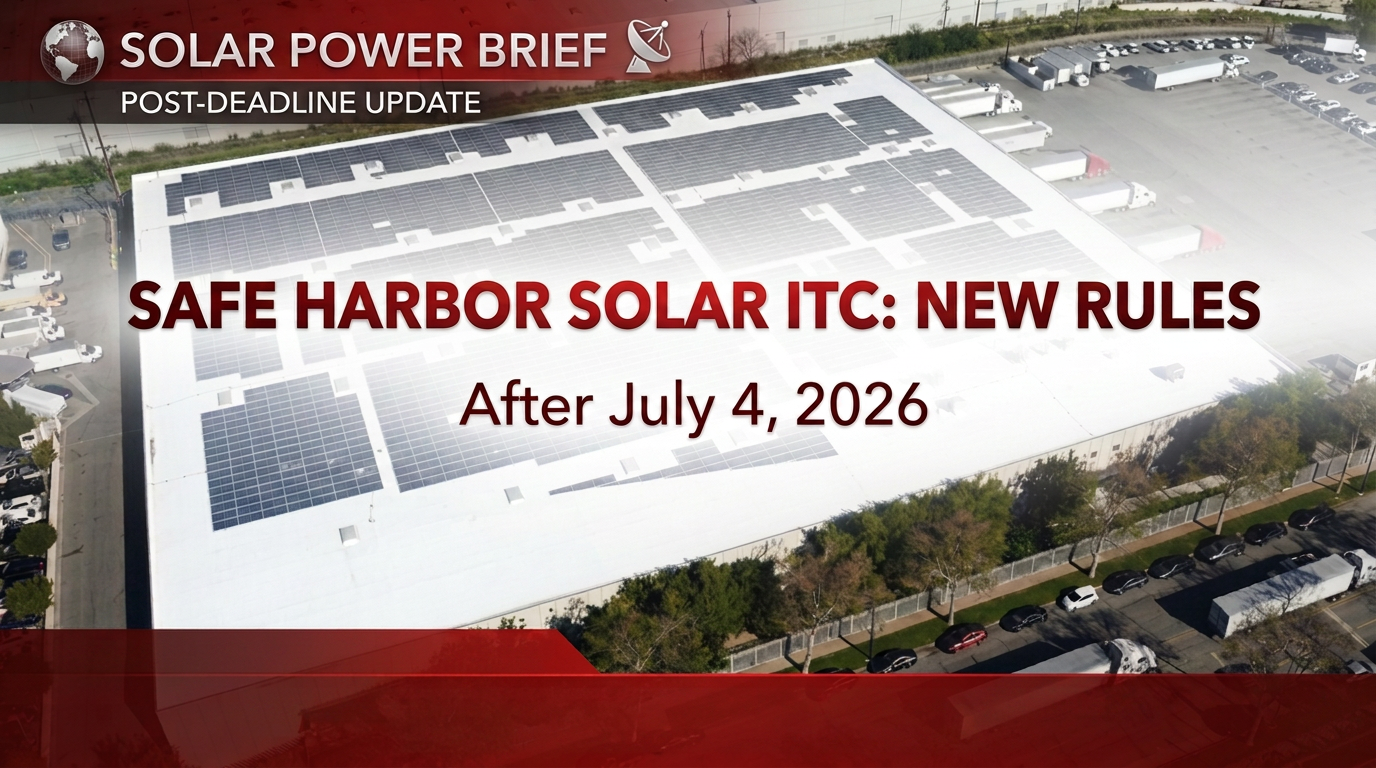
The residential solar industry spent June sprinting toward a July 4 deadline most homeowners never heard of. Now it's passed, and the market has quietly split into two groups: funds and installers who locked their position before the line, and everyone now racing a much shorter clock. If you sell solar, knowing which group your partners are in is no longer optional homework. It's your pricing forecast for the next eighteen months.
Standard disclaimer up front: this is market context, not tax advice. The rules below have edges, and the people who ride those edges are called tax attorneys.
The two-clock system, plainly
The homeowner credit — Section 25D, for purchased systems — died December 31, 2025. That funeral was well attended. What survived is the investment tax credit under Section 48E, claimed by the owner of a third-party-owned system: the lease or PPA provider. And the One Big Beautiful Bill Act left that credit running on two very different clocks, split by July 4, 2026:
- Began construction on or before July 4, 2026: the project must be placed in service within four calendar years — for construction begun in the first half of 2026, that means as late as December 31, 2030.
- Began construction after July 4, 2026: the credit survives only if the project is placed in service by December 31, 2027.
"Began construction" is a term of art with two historical tests — significant physical work, or the 5% safe harbor (incurring 5%+ of project cost). IRS Notice 2025-42 narrowed the field: solar and wind facilities starting construction from September 2, 2025 onward generally must use the physical work test, with an exception preserving the 5% route for low-output facilities of 1.5 MW or less. That's why the spring was full of trackers being staked and transformers being ordered: paper wasn't enough anymore.
One more layer with teeth: projects beginning construction after December 31, 2025 face the prohibited-foreign-entity sourcing rules — fall below the domestic-assistance thresholds (55% in 2026, rising as scheduled after) and the credit disqualifies. Safe-harbor positions established before the end of 2025 sidestepped that entirely, which made pre-2026 equipment war chests even more valuable than they looked.
What this means at the dealer level
You don't file any of these forms. You feel all of them anyway, through pricing.
A fund with a deep safe-harbor position is selling you stability. Their credit eligibility runs to 2030; they can hold PPA rates and dealer pricing steady while competitors sweat. A fund without one is selling against a December 2027 wall — every install they contract now has to be operating within about eighteen months, or their economics lose the credit that makes the deal pencil.
So ask your TPO partners direct questions, and expect direct answers:
- Did you establish begin-of-construction before July 4 — and how deep? "Yes" is a word; megawatts and dollars are an answer.
- What's your placed-in-service runway — and what happens to my pricing if install timelines slip into the crunch?
- Where does your equipment stand on the sourcing rules? Because a supply-chain compliance surprise in 2027 becomes your canceled pipeline.
And watch the calendar on install velocity. If any part of your channel is riding the 2027 clock, the industry-wide race to place projects in service will collide with finite installer labor in late 2027. Deals signed in mid-2027 without a protected pipeline behind them are the ones that get squeezed. Sell ahead of that, not into it.
The honest homeowner conversation
None of this changes at the kitchen table what it changed in the fund offices: for the homeowner, the credit story is simply that buying lost its federal credit in 2025, while third-party ownership kept one — which is why the lease or PPA quote looks the way it does. You don't need to explain continuity safe harbors at the door, and you shouldn't try. You need your own supply chain to have already handled them.
The scramble is over. The sorting has started. Make sure you know which side of it your partners are on before your competitors' reps figure out how to ask.
Selling solar in this market? Run your numbers with us.
GRID is the $0 operating platform for solar dealers — tools, training, commissions, e-sign, and installer pricing negotiated on pooled network volume. One 20-minute intro call. No pressure, no runaround.
Book the intro call →